
Methodology
Understand, Diagnose, Direct, Design, Build, Activate, Measure and Evolve. Learn the method Instfy uses to guide any client or challenge.
The Instfy methodology turns the way we think into a structured path that can be taught, repeated and measured. It works for an entrepreneur creating their first business, for a company that needs to grow and for a group entering a new market. What changes is each client's reality, not the way we get to the solution.
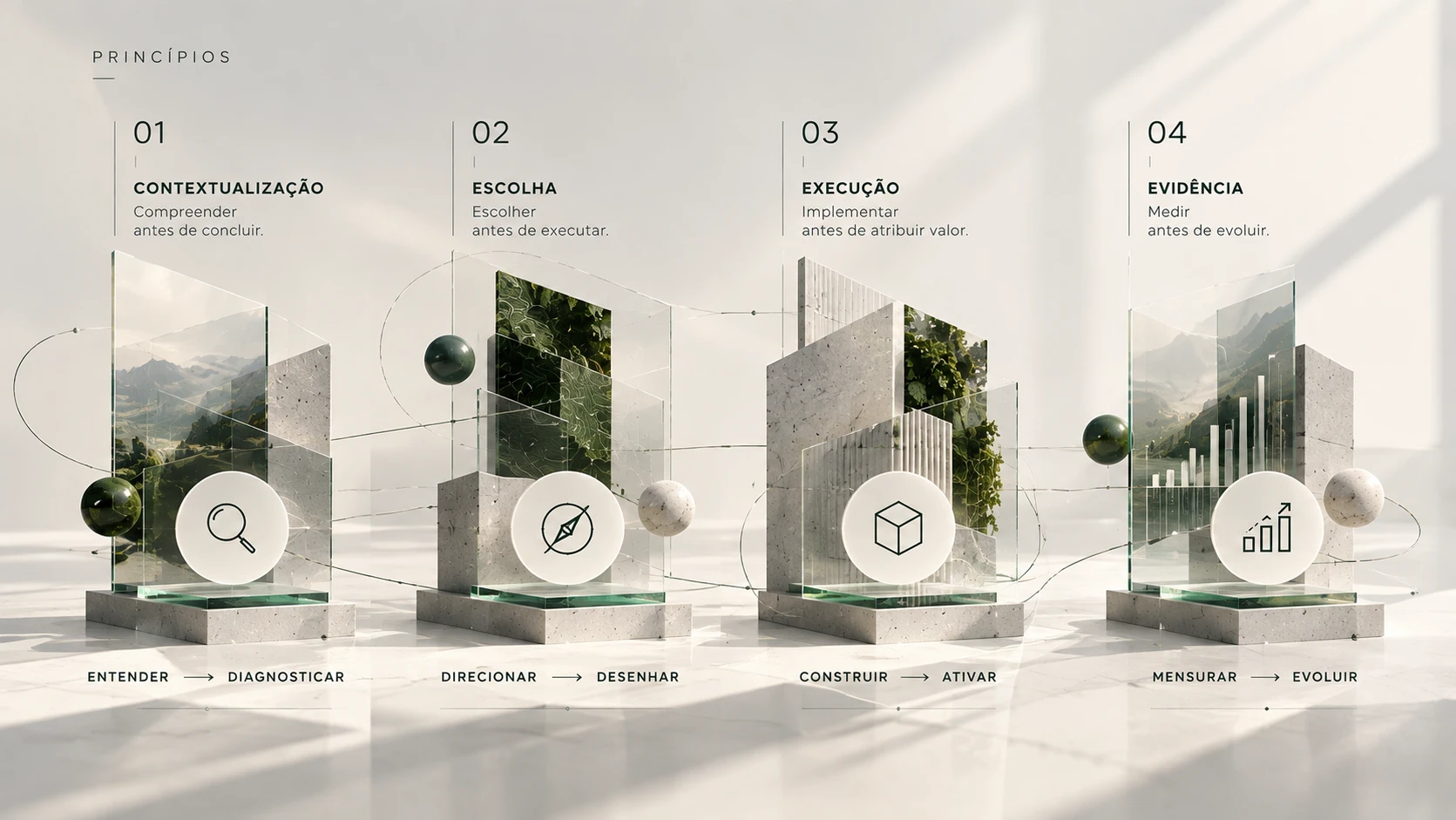
The four principles
The methodology rests on four principles. Each one guides a pair of stages.
| Principle | Motto | Stages |
|---|---|---|
| Context | Understand before concluding | Understand and Diagnose |
| Choice | Choose before executing | Direct and Design |
| Execution | Implement before claiming value | Build and Activate |
| Evidence | Measure before evolving | Measure and Evolve |
- Context: no solution exists in isolation. Before diagnosing, we understand the person, the business and the environment: context, ambitions, capabilities, constraints and external forces.
- Choice: strategy is not about chasing every opportunity. It is about deciding where to play, how to win, what to prioritize and what not to do.
- Execution: a strategy does not produce results just because it was defined. It needs to become concrete initiatives that are implemented and built into the operation.
- Evidence: we do not evolve based on perception alone. We measure results, compare expectations with evidence and learn from what happened.
1. Understand: understand before proposing
This is the foundation of the whole process, our Discovery. More than a kickoff meeting, it is a strategic stage that answers five questions:
- Who is the client? A company being created, a startup, a small or mid-sized business, a family business, a business group, an industrial company, retail, services, a franchise, a personal brand, a public institution or a multinational. The nature of the client changes the whole analysis.
- Where is it today? The company's current moment as an organism: history and stage, revenue model, products, customers, operations, people, technology, marketing and sales, finances, brand, data and differentiation.
- Where does it want to go? Business, financial and growth goals, brand, expansion and internationalization, new products and markets, technology transformation, succession and impact. And also what life the person behind the business wants to build.
- What context is it in? We analyze from the outside in: global, national, regional, local, business and individual.
- What are the constraints? Capital, time, team, execution capacity, legislation, operational limitations, dependence on the founder and risk appetite. Ambition without constraints produces unrealistic strategy.
Result: an accurate snapshot of the business, the people behind it and their ambition.
2. Diagnose: find the real problem
The diagnosis compares four views: what the client believes, what the data shows, what the market is doing and what could happen. We look for bottlenecks, inconsistencies, risks, opportunities, competitive advantages, underused assets and hidden problems.
We rigorously separate five categories of information:
| Category | Meaning |
|---|---|
| Facts | What we know. |
| Signals | What we are observing. |
| Hypotheses | What we believe may be happening. |
| Opportunities | What can be explored. |
| Risks | What needs to be protected. |
Example: the client comes in saying "I need to improve my marketing". The diagnosis may show that marketing is not the main problem, but rather a mismatch between positioning, product, price and the sales process.
3. Direct: choose where to go
Here we define the best path for that client, considering ambition, market, resources, risks, timing, capacity, personal goals and expected return. We may present different scenarios, for example conservative, growth and transformation, and clearly recommend one of them.
Result: a North Star (the big goal), priorities, objectives and a roadmap.
4. Design: design the right solution
We do not sell what we know how to do. We use what we know how to do to build what the client needs. Depending on the problem, we combine different areas of expertise:
| Area | What it includes |
|---|---|
| Business | Strategy, business model, new products, pricing, channels. |
| Brand | Positioning, identity, narrative, experience. |
| Growth | Marketing, content, media, acquisition, CRM, sales. |
| Technology | Websites, systems, apps, automations, integrations. |
| AI | Agents, copilots, data intelligence, automation. |
| Experience | Customer experience, journey, service, communities. |
There is no fixed package. Two clients rarely need the same combination.
Result: a blueprint with the solution architecture.
5. Build: turn strategy into reality
Strategy becomes a project, the project becomes work cycles, the cycles become deliverables and the deliverables are validated. Each initiative has an objective, owner, deadline, indicator and expected result, which keeps the operation from becoming a queue of tasks with no direction.
Example: for the objective "increase B2B revenue", the initiatives could be commercial repositioning, a new professional channel, a CRM rollout, sales team training, outbound prospecting and partnerships. Each one with its owner and its metrics.
Result: implemented solutions.
6. Activate: make it work
A CRM that is installed is not a CRM that works. A new brand is not a brand that has been absorbed. A sales process on paper is not a team selling better. This stage covers launch, rollout, training, onboarding people, communication, adjustments and initial support.
The question for this stage: has the solution truly become part of the business?
When the solution includes ERP Instfy, activation follows the implementation roadmap, which takes your team from first access to full operation.
7. Measure: measure impact on the business
We judge success by impact, not by the number of deliverables.
| Instead of saying | We say |
|---|---|
| "We delivered the new website." | "Website conversion went from X to Y." |
| "We implemented the CRM." | "The pipeline grew X% and response time dropped Y%." |
Indicators vary by project and may involve business (revenue, margin, recurring revenue), marketing (acquisition cost, leads, conversion), sales (pipeline, average deal size, win rate, sales cycle), customers (retention, satisfaction, lifetime value), digital (usage and conversion) and operations (productivity, automation, efficiency).
8. Evolve: turn learning into decisions
At the end of a cycle, we have information that did not exist at the start. We ask again: what changed, what did we learn, what worked and why, what no longer makes sense, what opportunities and risks have emerged, whether the business is still aligned with the goals of the people behind it and what the next most relevant move is.
Evolving can mean optimizing an operation, repositioning a brand, dropping an initiative, entering a new market, creating a product, adopting a technology or redefining the strategic direction. And then the journey starts again.
Frequently asked questions
What is the Instfy Discovery?
It is the first stage of the methodology (Understand). In it we map who the client is, where they are, where they want to go, what context they operate in and what their constraints are. The result is a strategic snapshot of the business that serves as the basis for every decision that follows.
Does the methodology work for any type of company?
Yes. It starts from each business's specific reality, so it applies to companies being created, small and mid-sized businesses, industrial companies, retail, services, franchises, institutions and multinationals.
Do I need to go through all eight stages?
The full journey is the recommended path, but the starting point and the depth of each stage depend on what was found in the Discovery. A client may, for example, already have a clear direction and focus the work on building, activating and measuring.
How does Instfy measure whether the work delivered results?
We record the baseline indicators right at the beginning of the project, define which changes we expect to bring about and track progress all the way to the result. The chain is always: starting reality, objective, initiatives, indicators, result and learning.
Next steps
See how the methodology works in practice: how we sell, deliver and organize each project.