
How we think
The logic behind every Instfy decision: why we exist, what we do, for whom, where we look for answers, when we make sense and how we turn context into solutions.
This page explains our worldview and the principles that guide our work with each client. It is the foundation of the Instfy methodology and of how we work.
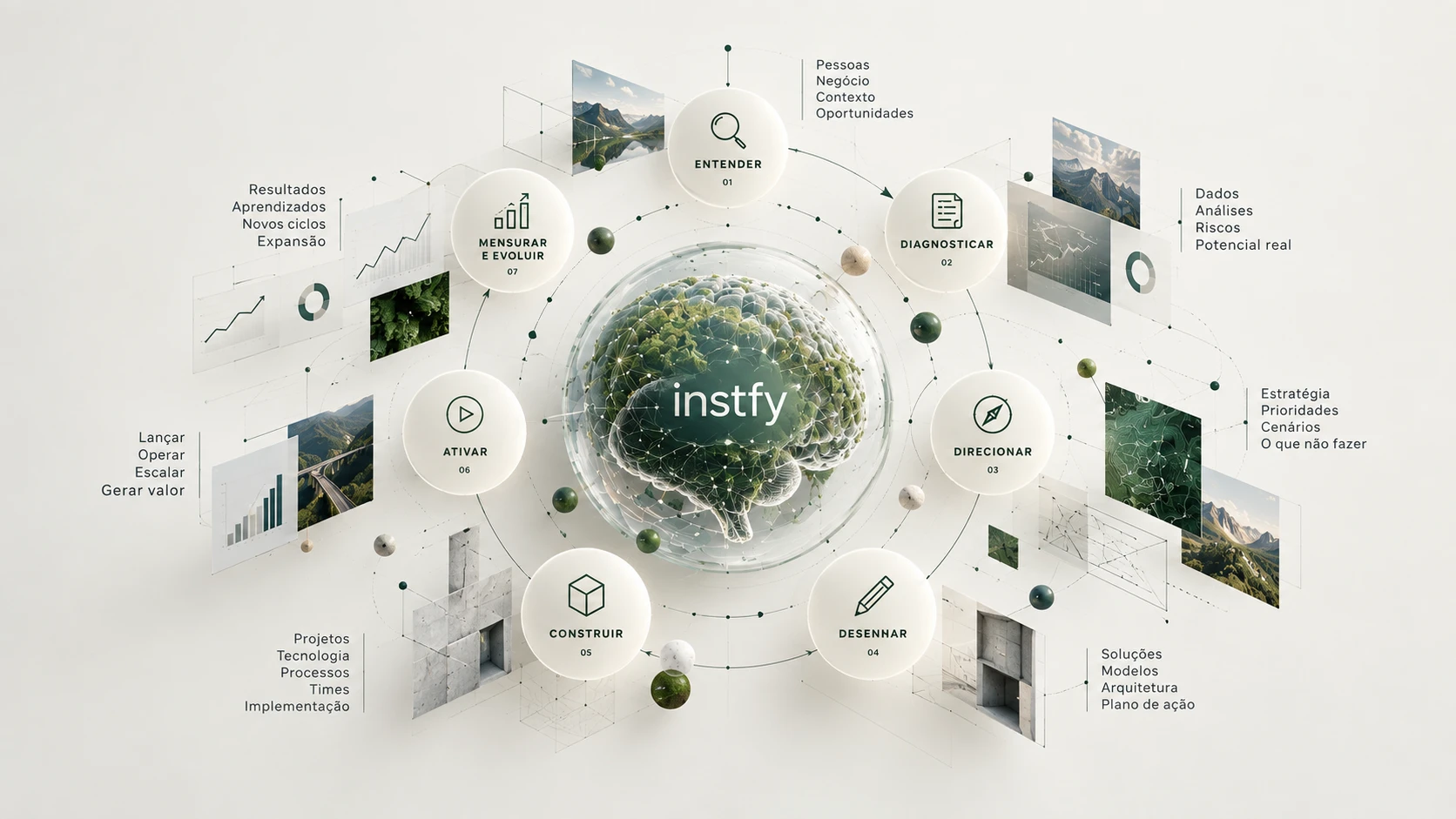
Everything flows
When we face a problem, the natural tendency is to look for a quick answer: reduce uncertainty, recognize a pattern, act. But finding an answer does not mean you have understood the problem.
Problems are the result of contexts, relationships, decisions and events that pile up. In business, that context involves people, culture, markets, technology, the economy and the moment the company is going through. None of these variables stands still.
About 2,500 years ago, Heraclitus of Ephesus summed up this idea in two words: "Everything flows." If people, behaviors, markets and technologies change all the time, some certainties also need to be questioned. When we do that, the obvious problem is no longer so obvious, and relationships and possibilities we could not see before start to appear.
Choosing also means saying no
Seeing more possibilities does not mean pursuing all of them. As Michael Porter put it, "the essence of strategy is choosing what not to do."
That is why our work is to:
- Understand reality.
- Expand the possibilities.
- Help you make better choices.
- Turn those choices into reality.
- Generate evidence to keep evolving.
Why do we do it?
We believe business is one of the most powerful ways to turn ideas into reality and make an impact on people's lives. Companies are built by people, with ambitions, limitations, stories and an idea of the future. We exist to help these people better understand what they are building, see possibilities they may not have noticed yet and make choices that bring their businesses closer to what they truly want to achieve.
What do we do?
We develop solutions for businesses. We keep this definition broad on purpose: a client's problem should not be limited to the solutions we already have ready. Today's challenges are multidisciplinary and can involve strategy, technology, communication, product, brand, sales, processes, artificial intelligence, data and people.
Reality determines the solution. First we understand what needs to be done. Then we find the best means to make it happen, whether with our team, with our products or with a network of specialists.
Who do we do it for?
For people and organizations that need support to create, transform or develop new paths: from entrepreneurs starting an operation to established businesses, industries, institutions, governments and international corporations. More than size, industry or geography, we look to work with those whose ambitions and principles are compatible with ours and who are willing to build.
Where do we look for answers?
We start by asking better questions. We observe what is happening in the world, in the country, in the region and in the local market, connecting other industries, technologies, business models and behavior shifts to each client's reality. Where a business is located does not limit where its best ideas and opportunities can come from.
When do we make sense?
When clarity is missing or there is a gap between the current reality and what you intend to build. When a transformation is needed, there is an opportunity to explore or a next stage to reach. You do not need to arrive knowing exactly what the problem is or what solution you are looking for: figuring that out is also part of our work.
How do we do it?
We broaden the view before narrowing the possibilities. We cross the reality of the people behind the business with what is happening inside and outside it. From that understanding, we turn context into possibilities, possibilities into choices and choices into solutions. Then we put them into practice, follow up, measure and learn.
This logic forms our eight-stage journey:
| Stage | In one sentence |
|---|---|
| 1. Understand | Get to know the client, the business, the context and the ambition. |
| 2. Diagnose | Find the real problem, the risks and the opportunities. |
| 3. Direct | Choose where to go and what to prioritize. |
| 4. Design | Design the specific solution for that reality. |
| 5. Build | Turn strategy into projects and deliverables. |
| 6. Activate | Put the solution to use and drive adoption. |
| 7. Measure | Measure the real impact on the business. |
| 8. Evolve | Learn and define the next move. |
The details of each stage are in Instfy methodology.
How does this become business?
Scope, investment and the relationship model follow what really needs to be done. We can work on a project, in an ongoing advisory relationship or, when interests and value-creation potential are aligned, in results-based models. Our economic model aims to be tied to the value we are able to generate, not just to the number of hours or deliverables.
We start from what our client wants to build, understand what really needs to happen and find the best way to make it happen.
Frequently asked questions
What is the central idea of the Instfy way of thinking?
Understand before concluding. Problems are the result of contexts that change all the time, so we broaden the view before narrowing the possibilities and only then make choices and build solutions.
Do I need to know exactly what to hire before talking to Instfy?
No. The first stage of our work is precisely to understand the business and figure out what needs to happen. The solution is defined from that understanding, not from a ready-made package.
Does Instfy only work with large companies?
No. We work with everyone from entrepreneurs starting an operation to established companies, industries, institutions and governments. What matters most is that there is a meaningful gap between the current reality and what you want to build.
Next steps
See how this way of thinking becomes a structured method.